The Green Party Looked At Canada — A Country Currently On Fire After Trying A Milder Version Of Their Own Policies — And Concluded The Problem Was Insufficient Ambition. Justin Trudeau Has Sent A Postcard From His Bunker Wishing Them Luck.

There is a particular kind of ideological confidence that can only be sustained by never, ever looking at the evidence. It is the confidence of someone who watches a man walk into a lamppost, concludes the problem was that he wasn't walking fast enough, and accelerates accordingly.
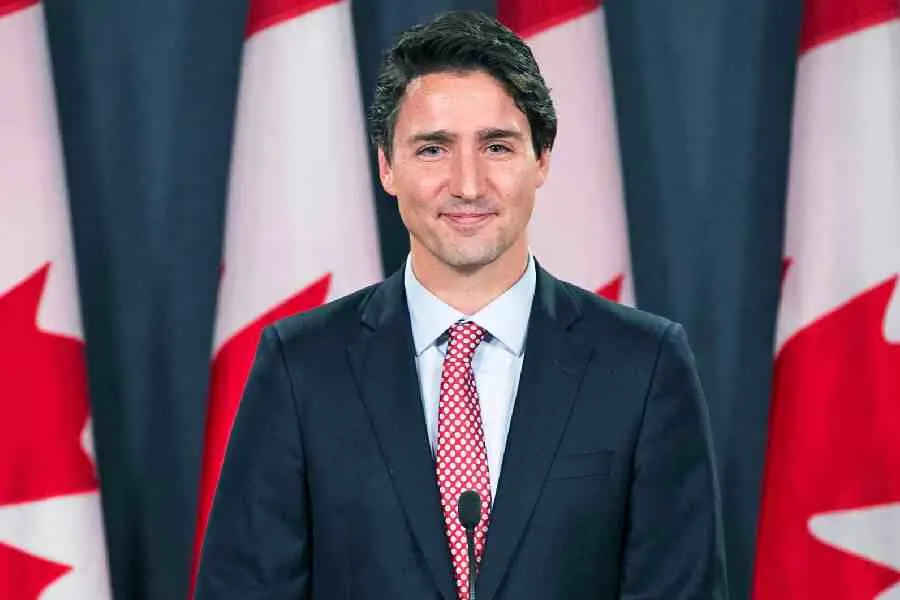 Photo: Justin Trudeau, via assets.telegraphindia.com
The Green Party of England and Wales has this confidence in abundance. And nowhere is it more magnificently, catastrophically on display than in their immigration policy, which manages to take everything Canada tried, strip out the bits that kept it merely disastrous rather than apocalyptic, and present the result as a moral breakthrough.
Canada: The Live Preview Nobody Wanted To Watch
Let us establish the baseline. Canada, under Justin Trudeau's Liberal government, ran what was — until the Greens came along — the most ambitious mass immigration programme in the developed world. At its peak, Canada was admitting over a million new permanent and temporary residents per year into a country of 38 million people. That is, proportionally, roughly equivalent to Britain admitting 1.5 million annually. Consistently. For years.
Canada had, throughout this period, a points-based system. It had application fees. It had income thresholds. It had, in other words, all the things the Green Party describes as 'barbaric barriers to human dignity.' And yet, equipped with all these supposedly cruel gatekeeping mechanisms, Canada still managed to engineer one of the most spectacular self-inflicted housing collapses in the history of peacetime liberal democracy.
The average house price in Vancouver is now, adjusted for sanity, a figure that makes a London estate agent wince. Toronto renters are spending upwards of 50% of their income on accommodation. GP registration in major Canadian cities has become a competitive sport. Emergency departments in Ontario hospitals reported waits of over 20 hours in 2023. A 2024 survey found that nearly 40% of recent immigrants to Canada said they were considering leaving because the quality of life they'd been promised bore no resemblance to the quality of life they'd found.
Trudeau resigned. He did not, it should be noted, resign before implementing the policies. He resigned after the consequences became politically unsurvivable. This is an important distinction. The damage was done on his watch, at his instruction, with his cheerful optimism providing the soundtrack. He is now, in the imagination of this publication at least, writing postcards from a well-appointed bunker, wishing the British Greens the very best.
What The Greens Learned From Canada
A reasonable person, surveying the Canadian experience, might conclude: high-volume immigration without sufficient housing supply, healthcare infrastructure, or integration support is a reliable route to social and economic destabilisation, and perhaps we should moderate our ambitions accordingly.
The Green Party of England and Wales looked at exactly the same evidence and concluded: Canada didn't go far enough.
This is not a caricature. Their published migration policy proposes to abolish the No Recourse to Public Funds condition — meaning every new arrival, from day one, accesses the full suite of welfare, housing benefit, and NHS provision. Canada never did this. Canada maintained the principle that new arrivals should, at minimum, support themselves financially during an initial period. The Greens consider this discriminatory.
Their policy proposes to dismantle the Home Office entirely. Canada kept its immigration ministry. Flawed, overwhelmed, occasionally farcical — but present. The Greens would replace Britain's equivalent with what their policy documents describe as a more 'humane administrative framework,' which in practice means a much smaller organisation with no enforcement powers and a statutory obligation to assume good faith in every single application.
Their policy proposes to abolish application fees. Canada charged fees. Significant ones. The Greens call this 'profiteering from desperation.' Canada called it 'partially offsetting the administrative cost of processing several hundred thousand applications per year.' Britain, under Green policy, would process an unknowable number of applications — the word 'unlimited' does not appear in their documents, but neither does any upper bound — entirely at public expense.
The Infrastructure Question Nobody Is Answering
Canada's collapse was, at its core, an infrastructure story. You can debate the cultural and social dimensions until you're blue in the face, but the most basic, inarguable problem was this: Canada did not build enough houses, train enough doctors, or lay enough GP surgeries to accommodate the population it was creating. It took the optimistic approach — assume the infrastructure will follow — and discovered that infrastructure does not, in fact, follow. Infrastructure requires planning, funding, time, and a government willing to have difficult conversations with existing residents about disruption. None of those things were abundantly available.
Britain, entering a Green administration, would face this problem at a steeper gradient and with fewer resources. The NHS is already operating beyond capacity. The housing waiting list in England already exceeds 1.3 million households. There are GP surgeries in the Midlands that stopped accepting new patients in 2021 and have not reopened their lists since. The school system in parts of the East Midlands is managing classroom sizes that would have caused a national scandal fifteen years ago.
Into this Britain, the Greens would open the doors — not merely wider than Canada's, but without hinges, without a frame, and with a sign on the outside reading 'All Public Services Available Immediately, No Conditions Apply.'
The Trudeau Postcard
Justin Trudeau, to his modest credit, at least believed the infrastructure would catch up. He was wrong, but he was sincerely wrong, which is a category of error distinct from the Greens' approach, which is to consider infrastructure concerns a form of dog-whistle politics unworthy of serious engagement.
His letter to the British Green Party — imagined here, but only barely — would presumably read something like: 'Tried the ambitious version. Lost the housing market, the health service, and eventually the election. You're proposing to try the ambitious version without the safeguards we kept. I admire the commitment. I am writing this from somewhere I'd rather not specify. Best of luck. You'll need it more than I did.'
The Greens, to be fair, would probably frame his resignation as proof that progressive policies need a more committed champion, rather than as evidence that the policies themselves were the problem.
This is the lamppost theory of political learning. And Britain, if the polls hold, is about to find out what it feels like to hit it at full speed.
Canada's housing affordability index has not recovered. Its immigration minister has been replaced three times in two years. The points system, income thresholds, and application fees — the very things the Greens call barbaric — are currently being quietly reinforced by the new Canadian government. Nobody is writing a think-piece about it. The Greens are not reading it anyway.