The Green Party Want To Accept Climate Refugees — Scientists Estimate That's Approximately Four Billion People And They've All Heard About The Free Benefits
The Noble Dream of Saving Climate Refugees
Poppy Fairweather-Smythe earned her First Class honours in Environmental Geography from the University of Bath with a dissertation on "Climate Justice and Global Migration Patterns." She knew, with the absolute certainty that only comes from three years of academic theory and zero real-world experience, that Britain had a moral obligation to accept climate refugees.
"We're literally the reason for the climate crisis," she proclaimed on TikTok, her video garnering 47 likes from her fellow graduates. "The least we can do is accept responsibility for the people we've displaced."
Six months after the Green government implemented her dream policy, Poppy is hiding in her parents' Cotswolds cottage, refusing to answer the door. Outside, there's a queue of approximately 3,000 people, all holding printouts from the gov.uk website confirming their eligibility for climate refugee status and immediate access to Universal Credit.
The queue stretches from her garden gate to the next village.
When Four Billion People Need Rescuing
Here's the thing about climate change: it affects everyone, everywhere, all the time. Rising sea levels? That's basically anyone within 200 miles of a coast. Changing rainfall patterns? There goes most of Africa, Asia, and half of South America. Extreme weather events? Well, that's literally everywhere that has weather.
The Green Party's commitment to "accept our responsibility for the climate emergency and support the people forced to move" sounded wonderfully progressive in the manifesto. What they forgot to mention was that by the UN's own broad definition of climate displacement, roughly 4.2 billion people currently qualify for protection.
All of them, it transpires, have heard about Britain's generous benefit system.
The Great Universal Credit Gold Rush
Day one of the new policy saw the DWP website receive 847 million unique visitors. The servers, designed to handle the benefit claims of 67 million Britons, lasted approximately 43 minutes before collapsing under the weight of applications from everyone who'd ever experienced a hot day, a cold snap, or insufficient rainfall.
"We're seeing unprecedented demand," admits Sir Quentin Butterworth-Thistlebottom, the new Green minister for Climate Justice and Reparations. "But this is exactly the kind of challenge we expected when we committed to accepting our historical responsibility."
Historical responsibility, it turns out, is expensive. Very expensive.
The Treasury's initial calculations suggest that providing Universal Credit to 4.2 billion climate refugees would cost approximately £847 trillion annually. For context, Britain's entire GDP is roughly £2.8 trillion. The maths, as they say, doesn't quite add up.
Meet Your New Neighbours
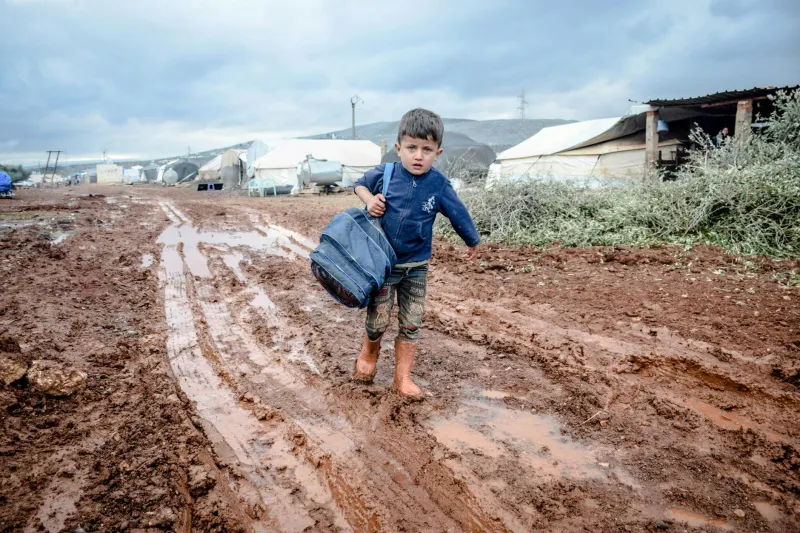
Poppy's Cotswolds village of Little Piddlington (population: 247) has experienced some changes since the policy implementation. The village green now resembles a refugee camp crossed with a music festival, minus the music and the toilets.
There's Raj from Mumbai, who claimed displacement due to "unprecedented monsoon variations" (it rained slightly less than usual). There's Ahmed from Cairo, fleeing "extreme desert conditions" (it was quite hot). There's Maria from São Paulo, escaping "catastrophic deforestation impacts" (someone cut down a tree near her house).
All perfectly legitimate claims under the Green government's refreshingly broad interpretation of climate displacement.
The local Tesco ran out of food on day three. The post office has been converted into a makeshift benefits processing centre. The village pub is now sleeping forty-seven people per room, all waiting for their Universal Credit payments to come through.
"This isn't quite what I had in mind," admits Poppy, peering through her parents' net curtains at the encampment that was once their prize-winning garden. "I thought we'd maybe accept a few thousand refugees, you know? Not literally half the world."
The Economics of Infinite Compassion
The Green government's commitment to providing full benefits to anyone claiming climate displacement has created some interesting economic dynamics. Universal Credit payments are now being processed in seventy-three languages. The DWP has hired 400,000 additional staff, mostly refugees who claimed displacement and then applied for the jobs.
Meanwhile, Britain's tax base remains stubbornly finite. The new Climate Refugee Solidarity Tax starts at 67% for basic rate taxpayers and rises to 94% for higher earners. Poppy's parents, both retired teachers, are now working night shifts at Amazon to pay for the privilege of housing climate refugees in their garden.
"We fully support the policy," insists Poppy's mother, Mrs. Fairweather-Smythe, through gritted teeth as she serves dinner to eighty-seven people in her kitchen. "We just didn't expect quite so many of them to end up here specifically."
The Application Process Goes Global
Word travels fast in the age of social media. WhatsApp groups across the developing world are sharing screenshots of successful Universal Credit applications, along with helpful guides on claiming climate displacement. "UK Benefits – Easy Money!" has become the most-watched YouTube series in Nigeria, Pakistan, and Bangladesh.
The application process itself has been streamlined for efficiency. Claiming climate displacement now requires only a simple online form and a brief statement explaining how climate change has affected you. Popular answers include "it was hot," "it was cold," "it rained," and "it didn't rain enough."
All applications are being approved automatically. The Green government abolished the concept of "bogus claims" as "inherently discriminatory against climate justice."
The Infrastructure Collapse
Britain's infrastructure, designed for 67 million people, is handling the influx about as well as you'd expect. The NHS has a waiting list of approximately 400 million people. School places are being allocated via lottery system, with roughly 12,000 children competing for each desk.
The housing market has entered what economists are calling "complete systemic collapse." Average house prices have dropped 97% due to the simple fact that nobody can afford to buy property when they're paying 94% tax to fund Universal Credit for half the world's population.
Poppy's parents' four-bedroom cottage, once worth £800,000, is now valued at roughly £23,000. "On the bright side," notes the estate agent, "at least it comes with its own refugee camp."
The Dawning Realisation
Poppy is slowly coming to terms with the mathematical reality of infinite compassion meeting finite resources. "I genuinely thought 'climate refugees' meant, like, a few islands that were sinking," she explains via Zoom from her parents' attic (the only room in the house not currently occupied by climate refugees). "I didn't realise it would include basically everyone who'd ever experienced weather."
The irony isn't lost on anyone with basic numeracy skills. The same progressive voters who demanded unlimited immigration and universal benefits are now discovering that the word "unlimited" has actual mathematical implications.
Meanwhile, Britain's carbon emissions have actually increased by 400% due to the sudden arrival of 4.2 billion new residents, all of whom quite reasonably expect access to heating, electricity, and transportation.
"We're saving the planet by destroying the country," observes Poppy's father, as he queues for three hours to use his own bathroom. "I'm not entirely sure that was the plan."
It wasn't. But it's what happens when you let geography graduates make economic policy.