You Voted Green Because They Promised A Post-Growth Economy And Now Britain's Most Successful Export Is Itself — Doctors, Engineers, And Anyone Who Passed A GCSE Have All Moved To Australia And The Only People Left Are The Ones Who Came For The Free Stuff

A Farewell Letter from Britain's Last Chartered Accountant
Written from the departure lounge at Heathrow Terminal 5
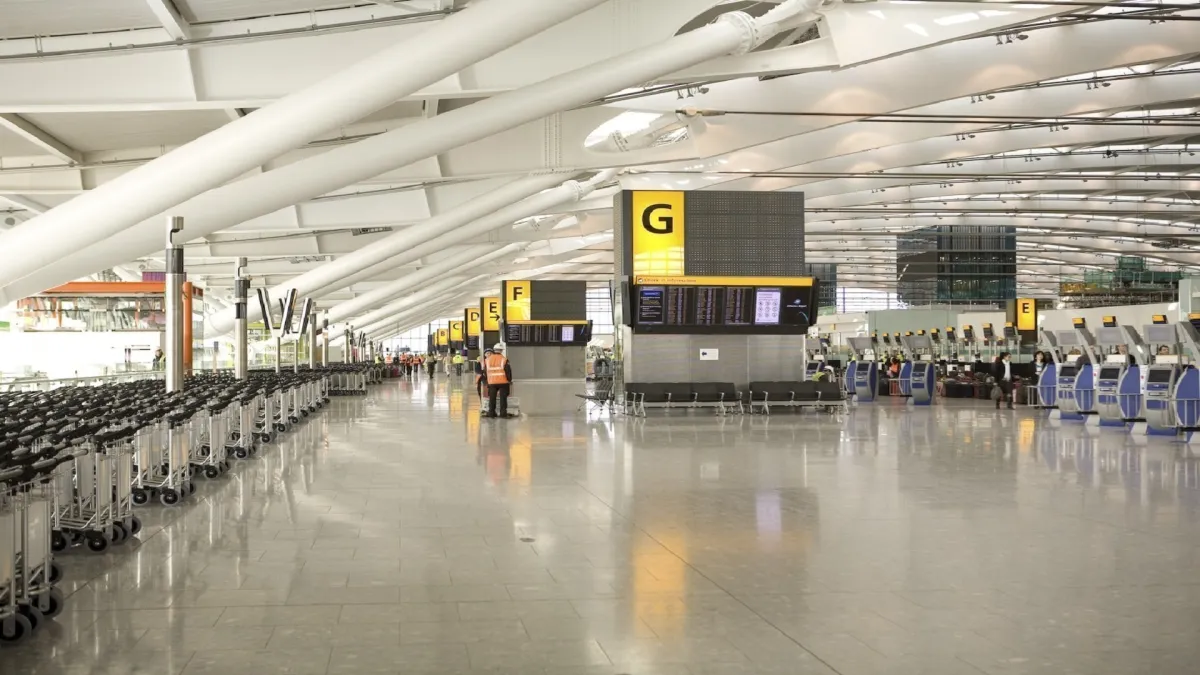 Photo: Heathrow Terminal 5, via muskita.com.cy
Dear Britain,
I'm writing this on my phone whilst queuing for the 14:30 to Sydney, surrounded by what appears to be the entire membership of the Royal College of Surgeons, three-quarters of Britain's software engineers, and a consultant anaesthetist who's crying into his flat white.
We're all leaving. Every single person with a professional qualification, a mortgage, and the basic mathematical literacy to calculate what the Green government's policies mean for anyone stupid enough to pay tax.
The Promise: Sustainable Economics for a Fairer Britain
Remember when you voted Green because they promised a 'post-growth economy'? You probably imagined Scandinavian-style social democracy with better bike lanes and locally sourced quinoa. Maybe you pictured yourself working four days a week at a meaningful job, spending your extra day teaching pottery to rescued hedgehogs.
You definitely didn't imagine Britain becoming a reverse economic miracle where the most successful export is British citizens and the most successful import is people who've never paid tax anywhere.
The Mathematics of Madness
Let me explain what 'post-growth economics' actually means when combined with open borders and universal benefits for all residents.
In 2024, Britain had roughly 32 million taxpayers supporting 67 million total residents. Not great ratios, but workable.
By 2027, after three years of Green governance, Britain has 18 million taxpayers supporting 78 million residents. The 14 million taxpayers who left have been replaced by 11 million new arrivals whose primary economic relationship with Britain involves receiving money rather than paying it.
Even a pottery teacher could see where this ends.
The Great Departure: When the Producers Leave
Dr Sarah Chen, consultant cardiologist, left for Melbourne in January. 'I was paying 73% effective tax rate to fund benefits for people who arrived last Tuesday,' she explains via WhatsApp from her new job at Royal Melbourne Hospital. 'My mortgage was £4,200 per month, my take-home pay was £3,800 per month, and my local council sent me a leaflet explaining that housing benefit claimants deserved priority over "privileged professionals." I sold my house to someone who'd never worked and moved to a country that appreciates doctors.'
Dr Chen's story is repeated across every profession that requires actual skills. Britain's engineering consultancies are now staffed entirely by recent graduates and people who arrived last week claiming to be engineers. The Royal College of Physicians has relocated its headquarters to Perth. The Institute of Chartered Accountants has opened a Brisbane branch that's larger than its London office.
The New Economic Model: Import Consumers, Export Producers
The Green Party's economic genius becomes clear when you examine the flows. Every month, Britain imports approximately 50,000 new residents whose first act is applying for housing benefit, Universal Credit, and NHS treatment. Every month, Britain exports approximately 30,000 taxpayers whose final act is selling their property to recent arrivals funded by housing benefit.
It's a perfectly sustainable economic model, provided you ignore the minor detail that it requires infinite taxpayers to fund infinite benefit claimants.
The Queue Analysis: A Study in Economic Incentives
From my position in the departure queue, I can see both directions of traffic at Heathrow. The queue to leave Britain consists of people carrying medical degrees, engineering qualifications, and accountancy certificates. Everyone has a job offer in Australia, Canada, or Singapore. Everyone is crying.
The queue to enter Britain consists of people carrying printouts of Green Party immigration policy and housing benefit application forms. Everyone has a smile and a mobile phone showing directions to the nearest council housing office. Nobody is crying.
One queue moves slowly because people are saying goodbye to the country they built. The other moves quickly because people are arriving at the country they heard about on TikTok.
The Millennial Reckoning: When Idealism Meets Payslips
Josh, 31, voted Green because he wanted 'economic justice' and 'sustainable growth.' He's now queuing three people behind me with a one-way ticket to Toronto.
'I thought post-growth meant working less and living better,' Josh explains, clutching his software engineering degree. 'Turns out it means working 70-hour weeks to pay for other people not to work at all. My tax bill was higher than my rent, and my rent was higher than most people's salaries. I'm moving to a country where being good at your job is considered a positive rather than a privilege that needs redistributing.'
Josh represents the educated millennials who voted Green with the best intentions. They wanted a fairer economy where hard work was rewarded and everyone had opportunities. They got an economy where hard work is punished through taxation and opportunities are reserved for people who didn't create them.
The Remittance Economy: Where Britain's Wealth Actually Goes
Meanwhile, Britain's new residents have created an economic innovation that would impress even the Green Party's post-growth theorists. They've discovered that British benefits can be converted into foreign investment through the simple mechanism of remittances.
Every month, approximately £2.4 billion leaves Britain as remittances to Pakistan, Bangladesh, Somalia, and other countries whose citizens have discovered that British taxpayers are more generous than their own governments. It's economic growth, technically, just not in Britain.
The money that Dr Chen earned treating British patients now funds her mortgage in Melbourne. The money that replaced Dr Chen's salary now funds property development in Lahore. It's a circular economy, in the sense that British wealth circulates rapidly out of Britain.
The Political Economy: Democracy by Import
The most brilliant aspect of the Green Party's strategy is that they've solved the problem of electoral accountability through demographic replacement. The taxpayers who might vote against their policies have emigrated. The benefit recipients who support their policies have been imported.
Birmingham's 2029 local elections featured a turnout of 340,000 voters, of whom 280,000 had arrived in Britain since 2024. The candidates' manifestos focused primarily on expanding benefits, increasing council housing, and improving relations with Pakistan. The candidate who suggested that Birmingham's budget might benefit from having some taxpayers to fund it finished seventh.
The Final Irony: Green Voters Leaving the Green Economy
The departure lounge is full of people who voted Green in 2024. Environmental scientists heading to Vancouver. Renewable energy engineers flying to Copenhagen. Sustainability consultants bound for Auckland.
They voted for a post-growth economy and discovered that post-growth means post-opportunity, post-prosperity, and post-future for anyone whose economic contribution involves creating wealth rather than consuming it.
The Empty Country: What's Left Behind
Britain in 2027 has achieved the Green Party's vision of economic equality. Everyone who remains has roughly the same income — zero from employment, maximum from benefits. The wealth gap has been eliminated through the simple expedient of eliminating the wealthy.
The country runs on imported expertise (doctors from countries that still reward medical training), imported goods (from countries that still manufacture things), and imported capital (remittances flowing in reverse from British emigrants who feel guilty about leaving).
It's a perfectly sustainable economic model, provided you don't need doctors, engineers, teachers, or anyone capable of calculating whether the numbers add up.
The Last Laugh: Who's Really Winning?
As my flight to Sydney is called, I can't help but appreciate the cosmic joke. The Green Party promised a post-growth economy and delivered exactly that — an economy that has definitively stopped growing because everyone capable of creating growth has left.
The educated millennials who voted Green to save the planet are now contributing to Australia's economy instead. The people who replaced them are contributing to Pakistan's economy through remittances. Britain's economy is contributing to the global understanding of what happens when you tax productivity to fund consumption.
It's the world's first truly circular economy: British wealth goes round and round, just never in Britain.
My plane is boarding. Australia needs doctors, and I need a country that thinks healing people is worth more than housing people who've never paid for either.
Britain's most successful export is itself. The only people left are the ones who came for the free stuff and the MPs who gave it to them.
Turns out that's not a sustainable economic model after all.
Dr Michael Thompson, former NHS consultant, future Australian taxpayer
Written somewhere over the Arabian Peninsula, en route to a country that still believes in growth