You Voted Green Because They Promised To Abolish No Recourse To Public Funds And Now Britain Has Discovered That 'Temporary' And 'Benefits' Are Two Words That Have Never Once In Human History Appeared Together Without Immediately Becoming Permanent — Your
The Instagram Infographic That Broke Britain
Chloe Henderson, 23, art therapy student from Bristol, cast her vote for the Green Party because she saw an infographic on Instagram that made her cry. Not tears of joy, mind you, but proper sobbing into her oat milk latte at the injustice of denying benefits to people who'd just arrived in Britain.
"It was so cruel," she explains from her shared house in Montpelier, where the council tax bill has recently required its own postcode. "How can you tell someone they can't access public services just because they haven't been here long enough? It's basically apartheid."
The infographic, featuring pastel colours and sans-serif fonts, explained that 'No Recourse to Public Funds' was a heartless Tory policy that prevented vulnerable people from accessing the safety net they desperately needed. What it didn't mention was that this 'heartless' policy was the only thing standing between Britain's welfare system and complete fiscal collapse.
When Temporary Became Forever (Spoiler: Immediately)
The Green Party's promise to abolish the NRPF condition was sold as a humanitarian gesture. Remove the bureaucratic barriers, they said. Trust people to use the system responsibly, they said. What could possibly go wrong with offering unlimited access to housing benefit, universal credit, and NHS services to anyone who fancied turning up?
Turns out, quite a lot.
Within six months of the policy's implementation, Britain discovered something that economists had been trying to explain for decades: if you offer free money with no strings attached, people will queue for it. And when those people tell their friends, family, and entire extended networks about the free money, the queue gets longer.
Much longer.
The Mathematics of Kindness
The DWP, now renamed the Department for Everyone Who's Heard About The Free Stuff, has released figures that would be hilarious if they weren't printed on official government letterhead. In the first year alone, benefit claims increased by 847%. Not 8.47%. Eight hundred and forty-seven percent.
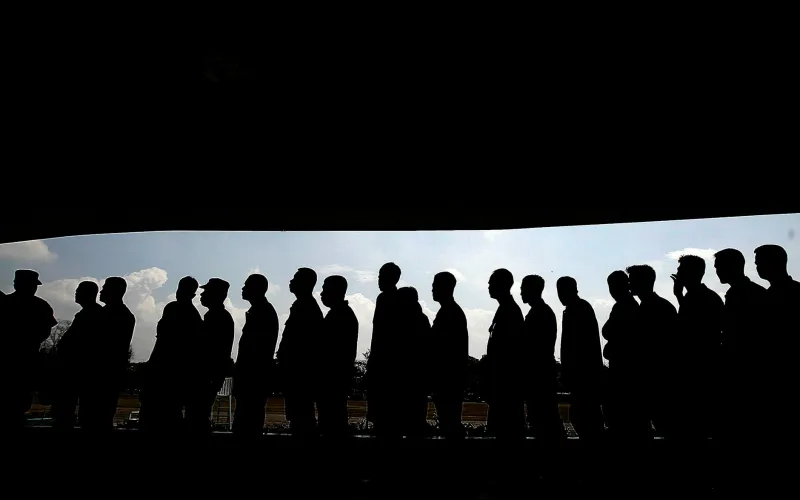
Chloe's local Jobcentre Plus in Bristol has had to expand into the neighbouring Tesco Express, the charity shop next door, and what used to be a pub called The Volunteer. The irony of that last one hasn't been lost on anyone.
"I didn't expect this many people," Chloe admits, watching a queue snake around her block for the third time this week. "But I suppose that just shows how much need there was. It's actually quite beautiful, in a way."
What's less beautiful is her tax code, which now resembles a phone number for a premium rate psychic hotline. The basic rate of income tax has been increased to 47% to fund what the Treasury has diplomatically called "expanded humanitarian commitments," though internal documents refer to it as "the money pit that ate Britain."
The GP Surgery That Became A Small Country
Dr. Sarah Williams runs what was once a quiet practice in Clifton. She now oversees a medical facility that processes more patients per day than some A&E departments, staffed by locums who've been imported from across Europe to cope with demand.
"We've had to implement a booking system based on lottery numbers," she explains, looking like she hasn't slept since the Green victory. "Last week, someone tried to book an appointment for their cousin in Karachi. When I explained he'd need to actually be in the country, they showed me a Green Party leaflet that said healthcare was a human right regardless of geography."
The practice waiting room has been expanded into the car park, the neighbouring Costa Coffee, and what used to be a small park. The council has had to install temporary traffic lights to manage the flow of people seeking medical attention, dental care, and what one patient described as "a general check-up for my entire extended family."
The Housing Association That Achieved Perpetual Motion
Bristol Community Housing Association used to manage 2,400 properties. They now have a waiting list of 34,000 people, all of whom are legally entitled to accommodation under the expanded humanitarian housing scheme.
"We've had to get creative," explains housing officer Mark Thompson, who's been working 16-hour days since the policy launched. "We're now offering shared bedrooms, shared beds, and what we're calling 'rotational tenancies' where people get the flat for eight hours at a time."
The association has converted every available space into temporary accommodation: the office building, the underground car park, and a disused telephone box that's now technically a studio flat for £400 per week, paid for by housing benefit.
The Conference Circuit Conclusion
Chloe remains optimistic. She's currently attending a Green Party conference session titled "Why Abolishing NRPF Didn't Go Far Enough: Towards Universal Basic Everything for Everyone Everywhere."
"The only problem with the policy," she explains over sustainably sourced quinoa, "is that we didn't make it global from day one. Why should geography determine access to British benefits? It's basically nationalism."
The session is being livestreamed to viewing parties in Lagos, Dhaka, and what the programme describes as "everywhere else that's heard about the free money."
Meanwhile, back in Bristol, the queue for benefits has reached the M4 motorway, the NHS has started issuing appointment times in 2027, and the local council has quietly changed its motto from "Bristol: European City of Culture" to "Bristol: Please Stop Coming."
Chloe's tax code now has fourteen digits. Her phone number has eleven. She's still not sure why this is relevant, but her accountant has started crying every time they meet, which seems like it might be connected.