You Voted Green So Everyone Could Access Healthcare And Now Your Appointment Is In 2034, Your Consultant Speaks Through An Interpreter, And The Blood Pressure Monitor Emigrated To Bulgaria With The Last Nurse Who Knew How To Use It
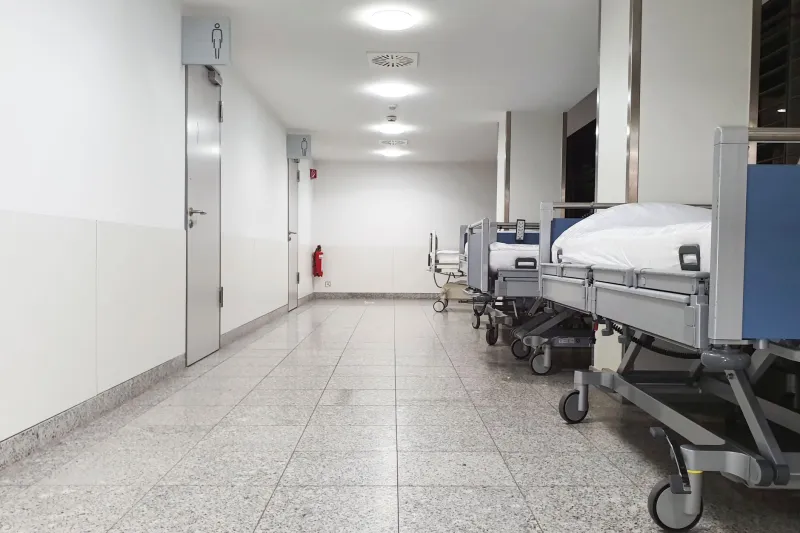
The NHS was, before all of this, already in a condition that medical professionals described using terms like 'critical,' 'unsustainable,' and, in one memorable British Medical Journal editorial, 'a controlled demolition that forgot to stop.' Waiting lists were at record highs. A&E departments were operating on a system that could charitably be described as 'whoever looks worst gets seen first and everyone else waits in a plastic chair next to a man who definitely should have called 111.'
You voted Green because they promised to fix it. More funding. More staff. Healthcare as a human right, not a postcode lottery. These are, again, not stupid things to want. The problem — and it is a problem of such magnificent, architectural stupidity that future historians will study it the way we study the Charge of the Light Brigade — is that they then combined this promise with policies that guarantee the opposite outcome.
The Equation That Doesn't Balance
Let's do some basic maths. The NHS currently treats roughly 1.2 million patients a day. It employs about 1.4 million staff. It costs approximately £180 billion a year and still can't manage to answer the phone before the third Tuesday of next month.
The Green Party's migration policy abolishes No Recourse to Public Funds — the rule that prevents newly arrived migrants from accessing benefits and public services — on day one. It treats all migrants as citizens. It removes visa quotas. It commits to accepting climate-displaced people from any nation that experiences adverse weather, which, as a category, now includes most of the planet including, technically, parts of Kent.
The result of combining 'NHS as universal human right' with 'no limits on who can access it' and 'no restrictions on public funds from day one' is not a better NHS. It is a NHS that is now theoretically responsible for the healthcare of anyone who can get to Britain, which under Green border policy is anyone who wants to come, which is a population that actuaries have stopped attempting to model because the spreadsheet keeps crashing.
The additional demand is not marginal. It is not 'a bit more pressure on the system.' It is the difference between a bridge rated for ten tonnes having eleven tonnes on it — uncomfortable but manageable — and having eleven thousand tonnes on it. The bridge does not flex. The bridge does what bridges do.
The Staff, Who Have Also Noticed
British-trained doctors and nurses are, it turns out, internationally mobile professionals with skills that are in demand everywhere on earth. When the NHS began collapsing under unmanageable demand, the rational response for a qualified consultant with a mortgage and two children was not to stay and absorb the chaos out of patriotic duty. The rational response was to move to Australia, where the hospitals are funded, the waiting lists are human-scale, and nobody has recently abolished the concept of a border.
This is what happened. It is still happening. The NHS lost a net 23,000 clinical staff in 2031, the highest figure ever recorded, and the Government's response was to recruit internationally — which is fine, except that international recruitment under Green policy means recruiting from countries whose medical registers have variable standards, whose practitioners may require translation services mid-consultation, and whose training in certain specialisms does not map cleanly onto British clinical pathways.
This is not a racist observation. It is a logistical one. A consultant who trained in a system with different equipment, different protocols, and different diagnostic frameworks requires onboarding, supervision, and time. Time is the one thing the NHS does not have. The waiting lists don't pause for induction weeks.
The blood pressure monitor went to Bulgaria with a departing cardiology registrar who had, frankly, had enough. This is not a metaphor. Equipment walks out with staff. The procurement budget to replace it was reallocated to the climate reparations fund in the last spending review. The cardiology ward is currently using a monitor borrowed from the GP surgery next door, which needs it back by Thursday.
The Human Right That Nobody Costed
The philosophical case for healthcare as a universal human right is coherent and, in many respects, compelling. The practical case for delivering it to an uncapped population through a single-payer system funded by a nation of 67 million people who are increasingly emigrating is less compelling. It is, in fact, the kind of idea that sounds magnificent in a university seminar and produces scenes in real life that would not look out of place in a documentary about a country that has recently experienced a significant institutional failure.
In Coventry, the A&E triage system now operates in eleven languages simultaneously. The translation service — contracted to a company that also, coincidentally, provides translation services to the Home Office, which no longer exists — costs £4.2 million per year per trust and is considered essential because the alternative is treating patients without understanding their symptoms, which is both dangerous and, under Green policy, legally actionable as a form of discrimination.
In Leeds, the GP surgery waiting list for a non-urgent appointment currently stands at nineteen weeks. The surgery has 4,200 registered patients. It also has 1,100 walk-in patients — people with no GP registration who are entitled, under the abolition of No Recourse conditions, to access NHS primary care immediately. The GP, who trained for seven years and had a nervous breakdown in 2030 that she described as 'informative,' sees forty patients a day. She has not taken a lunch break since the autumn.
What Healthcare As A Human Right Actually Requires
Here is what the Green Party did not say in their manifesto, possibly because it would have been difficult to fit on a sunset poster: healthcare as a universal human right requires money, staff, infrastructure, and — crucially — a defined population of recipients that the system is sized to serve.
You can have open borders or you can have a functioning NHS. You cannot, with the budget of a medium-sized European nation and a workforce that is actively leaving, have both simultaneously. Every comparable system that has tried has either introduced demand management, restricted access, or watched quality collapse. Sweden did it. Canada is doing it. Germany has been quietly reintroducing GP registration requirements since 2029.
The Greens know this. They must know this. The data is not obscure. And yet the policy exists, implemented in full, because it sounded right — because the moral logic was clean even when the fiscal logic was a disaster.
Your appointment is in 2034.
Bring snacks. The vending machine has been out of order since the engineer who fixed it moved to Brisbane.
He sends his regards.