The Green Party Replaced 'Hostile Environment' With 'Boundless Welcome' And Britain Is Now The Case Study That Political Science Lecturers In Stockholm, Zurich, And Ottawa Use To Explain To Their Students Why Even Very Nice Ideas Require Load-Bearing Wall
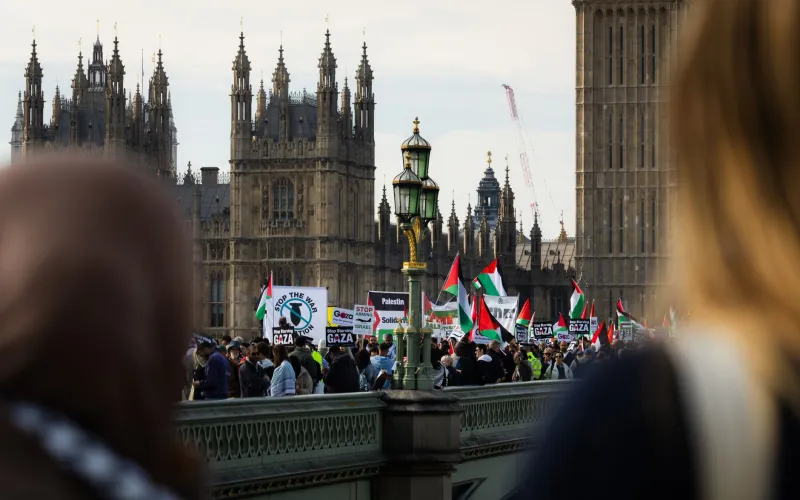
The Green Party Replaced 'Hostile Environment' With 'Boundless Welcome' And Britain Is Now The Case Study That Political Science Lecturers In Stockholm, Zurich, And Ottawa Use To Explain To Their Students Why Even Very Nice Ideas Require Load-Bearing Walls — Sweden Has Sent Flowers And A Pamphlet
There is a particular kind of political tragedy that begins with the best of intentions, proceeds through a series of individually defensible decisions, and ends with a country looking at itself in the mirror and not quite recognising what it sees. The tragedy isn't that the people involved were evil. The tragedy is that they weren't. They were, in the main, decent, educated, well-meaning people who believed that openness was its own reward and that the mechanisms holding a society together — borders, civic requirements, democratic accountability tied to membership — were relics of a nastier age that a more enlightened generation could safely discard.
Lebanon thought this in 1970. Turkey's secular establishment thought it in 2002. Sweden thought a version of it in 2015 and spent the following decade painfully, expensively, and publicly reconsidering. Britain, having watched all three, has decided to call their bluff and go further.
The Green Party calls this progress. Political scientists call it a natural experiment. Sweden calls it Tuesday.
The Mechanism Nobody Wanted To Name
To understand what happens when you combine unrestricted immigration, abolished public fund conditions, and voting rights extended to all residents regardless of citizenship, you don't need ideology. You need arithmetic.
Britain's Green government has done all three. The Home Office is dismantled — its functions distributed between a network of regional welcome hubs staffed largely by people whose previous experience was in charity sector outreach. No Recourse to Public Funds is abolished — every resident, from day one, accesses the same welfare, housing, and healthcare entitlements as a lifelong citizen. And every UK resident, citizen or not, now votes in general elections.
In isolation, each policy has a coherent humanitarian rationale. Together, they create a feedback loop that no democratic theorist in history has managed to make work sustainably, because the loop runs as follows: open entry creates large incoming populations; those populations, once enfranchised, vote according to their own interests and cultural priorities; those votes shift electoral outcomes toward parties and candidates who reflect those priorities; those parties and candidates then further entrench the policies that produced the demographic shift in the first place.
This is not a conspiracy theory. It is not racist to observe it. It is the same dynamic that every political scientist who has studied Lebanon, Bradford, certain municipalities in Belgium, and the outer suburbs of Stockholm has documented in peer-reviewed literature. The Greens have read this literature. They have categorised it under 'right-wing panic' and moved on.
What Lebanon Actually Tells Us
Lebanon's constitution was a masterpiece of pluralist accommodation. Power was shared between religious communities according to a census taken in 1932 — Maronite Christians got the presidency, Sunni Muslims got the prime ministership, Shia Muslims got the speakership of parliament. It was intricate, fragile, and premised on the demographic balance remaining roughly stable.
When Palestinian refugees arrived in large numbers after 1948 and 1967, Lebanon extended them residency and, progressively, significant political and civic rights. The Palestinian population, with its own political structures, armed factions, and external sponsors, became a state within a state. The demographic and political balance that the Lebanese constitution had been designed to manage was altered in ways that the constitution had no mechanism to absorb.
What followed — fifteen years of civil war, the destruction of Beirut, the permanent fracturing of Lebanese civic identity — was not caused by Palestinian refugees being bad people. It was caused by a political system failing to account for the reality that extending full civic rights to a large incoming population with different allegiances and external patrons changes what the polity is, whether or not that was anyone's intention.
Britain's Greens have looked at Lebanon and concluded that the lesson is more funding for community cohesion officers. The community cohesion officers are doing their best. There are currently 847 of them covering a country of 70 million people.
The Turkish Illustration
Turkey's secular democratic tradition, established by Atatürk and maintained — imperfectly, sometimes brutally, but maintained — for seventy years, did not collapse because of a coup or an invasion. It was incrementally displaced through democratic means by a party that understood exactly how to use electoral systems designed for a pluralist society to produce outcomes that pluralism had never intended.
The AKP under Erdoğan won its first election in 2002 with 34% of the vote. It then spent two decades using the mechanisms of democratic governance — elections, appointments, constitutional amendments — to reshape Turkish institutions in its own image. By the time the secular establishment understood what had happened, the institutions they might have used to reverse it had already been captured.
The mechanism in Turkey was not immigration — it was the exploitation of a democratic system by a movement that understood the system better than the system's defenders did. The mechanism in Britain combines both: an incoming population that is, in significant part, drawn from countries with conservative religious and social values, extended full voting rights immediately, in a country whose progressive governing party believes that all cultural values are equally compatible with liberal democracy because to suggest otherwise is bigotry.
Three English council areas now have majorities on planning committees who have voted to restrict mixed-gender public swimming sessions. Two have passed non-binding motions on blasphemy. One has a by-law under consultation that would require alcohol to be sold in separate, screened sections of supermarkets. The Green councillors in each area voted for these measures on the grounds of cultural sensitivity and community accommodation.
The Green Party national executive has described this as "local democracy in action." It is, technically, correct.
Sweden's Pamphlet
Sweden tried a version of this. Not the full version — Sweden retained borders, retained citizenship requirements for full civic participation, retained a functioning immigration bureaucracy. But Sweden in 2015 opened its doors wider than any comparable European nation, accepted more refugees per capita than anywhere except Lebanon, and spent the subsequent decade dealing with the consequences: parallel social structures in certain suburbs, a firearms homicide rate that went from negligible to the highest in Western Europe, and an electoral backlash that brought the Sweden Democrats — a party with roots the Swedish establishment spent decades trying to pretend didn't exist — into effective government.
Sweden did not become a fascist state. Sweden course-corrected, expensively and painfully, because it still had the institutional capacity to do so. It had not dismantled its Home Office equivalent. It had not extended voting rights to non-citizens. It had not abolished public fund conditions.
Britain has done all three. Sweden's pamphlet — a slim, diplomatically worded document entitled Lessons From Nordic Integration Policy — arrived at the Foreign Office in January. It has been acknowledged. It is in a pile with the Consequences Officer's memos.
The pile is, by all accounts, quite impressive now. Someone has suggested it be repurposed as a load-bearing wall. Given that the Greens removed all the other ones, it might be the most structurally useful thing in the building.