You Voted Green To Save Pakistan's Flood Victims And Now Britain Is Personally Financing A Nuclear-Armed Government That Jails Its Own Journalists — The Aid Budget Has A New Line Item Called 'Climate-Resilient Ordnance'
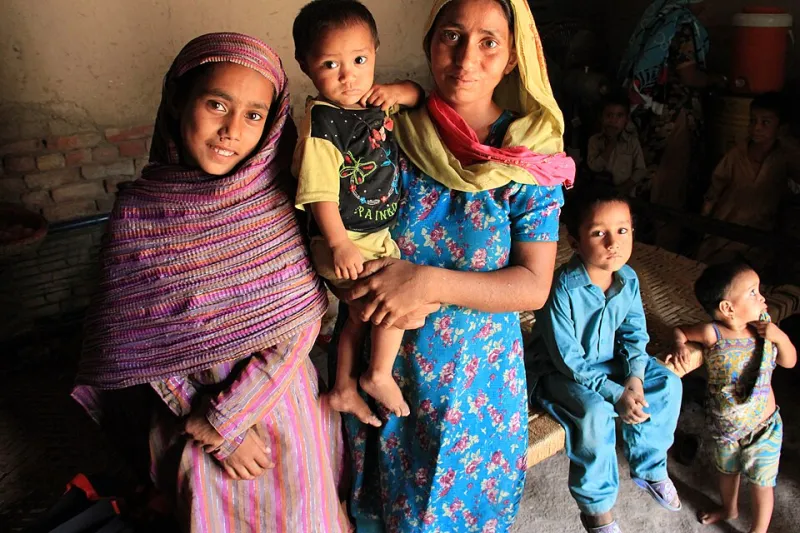
Photo: DFID - UK Department for International Development, CC BY 2.0, via Wikimedia Commons
You Voted Green To Save Pakistan's Flood Victims And Now Britain Is Personally Financing A Nuclear-Armed Government That Jails Its Own Journalists — The Aid Budget Has A New Line Item Called 'Climate-Resilient Ordnance'
The images were real. The flooding in Sindh was catastrophic. Thirty million people displaced, crops destroyed, entire villages swallowed by water that had nowhere else to go on an increasingly unforgiving planet. If you watched that footage and felt a pull of moral obligation, you were not wrong to feel it. That instinct — something must be done — is a decent one.
The question, which the Green Party has consistently refused to engage with on the grounds that questions are a form of structural violence, is: done by whom, through whom, and with what safeguards?
Because "done" and "done well" are not the same thing. And the gap between them, in this particular case, contains a Pakistani military procurement budget, a nuclear programme, a suppressed press corps, and a foreign aid administrator in Whitehall who has just discovered that the cheque they sent to Islamabad cleared in forty-eight hours and the flood victims are still waiting.
The Policy, In Plain English
The Green Party's position, stripped of its humanitarian packaging, is this: Pakistan is a climate victim. Climate victims have a right to support — financial, diplomatic, and migratory. Britain, as a historic emitter, bears specific responsibility. Therefore, Britain should open its aid budget, its diplomatic influence, and ultimately its borders to Pakistanis displaced by climate events.
This sounds, in a Islington dinner party context, entirely reasonable. It sounds less reasonable once you know that Pakistan's government has, over the past decade, imprisoned its most popular elected leader, shot at protesters, expelled international journalists, run an ISI that has a documented relationship with groups Britain officially considers terrorist organisations, and maintained a nuclear arsenal it periodically waves at India when the domestic news cycle needs redirecting.
But sure. Climate victims. Let's write the cheque.
A Brief History Of This Exact Mistake
We have been here before. Not metaphorically. Literally. The script exists. It has been performed twice in living memory to standing ovations from the Western left, followed by thirty years of consequences that are still being managed.
Iran, 1979. The Shah was genuinely awful — authoritarian, brutal, backed by American interests that had no business being there. Western progressives celebrated his removal with an enthusiasm that temporarily blinded them to what was replacing him. Khomeini was, in the early coverage, described by credulous journalists as a "moderate religious figure" who would "stabilise" the country. The liberals who'd marched against the Shah found themselves, within two years, in prison or exile. The revolution ate its progressive sponsors for breakfast and has been digesting them ever since.
The Green Party's relationship with Pakistan has this flavour. The genuine grievance — climate damage, historic exploitation, real poverty — is being used as a moral crowbar to prise open British policy in ways that will not benefit the flood victims of Sindh. It will benefit the Pakistani state apparatus, which has a forty-year track record of absorbing international sympathy and converting it into institutional power.
Lebanon, 1975 onwards. A functioning, pluralist, cosmopolitan state — the "Paris of the Middle East," genuinely — undone not by a single dramatic revolution but by a slow accumulation of accommodations. Each one reasonable in isolation. Each one, in retrospect, a brick removed from a load-bearing wall. Hezbollah was not imposed on Lebanon. It grew inside it, nurtured by a political culture that confused tolerance with the absence of standards. By the time anyone was willing to say the quiet part out loud, the quiet part had an army.
The Greens, to their credit, have studied none of this. Their policy documents cite Lebanon approximately never.
The Aid Money: Where It Goes
Pakistan received $9.7 billion in international climate aid between 2022 and 2024. Independent audits — the ones that Pakistani authorities permitted, which is a meaningful caveat — traced approximately 34% of it to intended beneficiaries. The remainder entered a system that the Financial Times once described, with admirable restraint, as "opaque."
The Pakistani military's budget increased in both years following major international aid disbursements. This is, charitably, a coincidence. Less charitably, it is a pattern so consistent it has its own Wikipedia page.
Britain, under Green policy, has committed to treating Pakistani climate displacement as equivalent to refugee status, which means not just aid but automatic eligibility for the full suite of settlement rights the party has simultaneously made impossible to refuse. No recourse to public funds condition: abolished. Minimum income requirements: abolished. Time-based settlement hurdles: abolished.
The flood victims of Sindh are real. But the people who will use this policy are not exclusively — or even primarily — the flood victims of Sindh. Pakistan has 240 million people. Its flood plains overlap with most of its agricultural heartland. Under the Green definition of climate displacement, which requires no individual proof of loss, just origin from an affected region, the eligible population is essentially the entire country.
Islington thinks this is fine. Rotherham is not consulted.
The Minorities Nobody Mentions
Here is the part that exposes the Green position as not merely naive but actively incoherent.
Pakistan's Ahmadi Muslims are legally classified as non-Muslims by the Pakistani constitution and face systematic state-sanctioned persecution. Pakistan's Christians are subject to blasphemy laws that carry the death penalty and are enforced with terrifying frequency. Pakistan's Shia community faces regular sectarian violence. Pakistan's Hindu minority has been in accelerating decline for decades.
These are the people whose persecution drives secondary and tertiary migration to Britain — people fleeing not floods but the Pakistani state itself, and the social structures that state protects and enables.
The Green Party's response to this is to align diplomatically with Islamabad, treat the Pakistani government as a legitimate climate partner, and funnel aid through institutions that actively suppress the minorities whose suffering the Greens claim to care about.
The cognitive dissonance required to hold this position is, genuinely, impressive. You'd need a degree to manage it. Several, probably.
The Punchline
In Islington, they're hosting a fundraiser. The theme is climate justice. There's a Pakistani street food stall — very good, actually — and someone has made a banner that reads "No Borders, No Bombs."
In Islamabad, the defence ministry has taken delivery of new equipment. The invoice is, by a remarkable coincidence, denominated in pounds sterling.
The flood victims of Sindh are still waiting.
But at least Britain's conscience is clean. That's what matters.