You Voted Green To Save The Planet And Now The RAF Has Sold Its Last Typhoon To Pay For Solar Panels In Chad — Britain's Air Defence Is Currently A Strongly Worded Letter And Three Volunteers With Binoculars
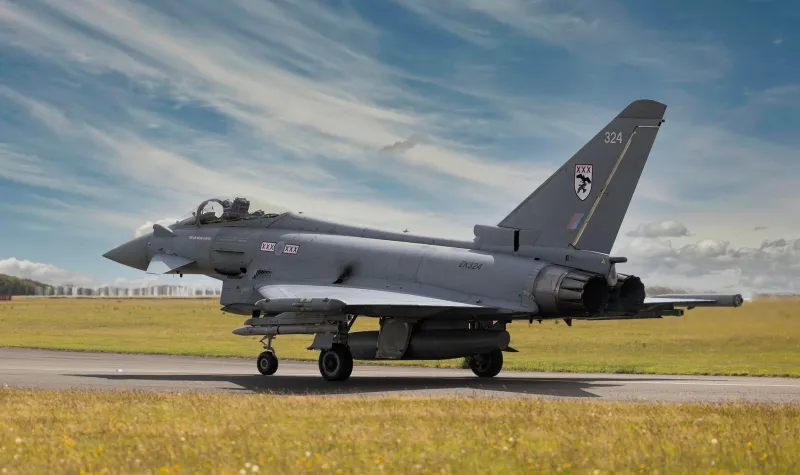
You were twenty-three, idealistic, and absolutely certain that the single biggest threat facing Britain was the carbon footprint of a Ryanair flight to Malaga. The Greens agreed. They had a poster. It had a sunset on it. You voted for them.
Congratulations. Britain is now technically the world's most morally advanced nation. It is also, as of the third quarter of 2031, unable to scramble a fighter jet without first submitting a climate impact assessment and waiting six to eight weeks for a response from the newly formed Ministry of Global Ecological Accountability, which operates out of a converted Pret a Manger in Whitehall and smells faintly of oat milk.
The Policy That Sounded Beautiful At A Festival
The Green Party's position on climate reparations was, in fairness, clearly stated. They were going to make Britain 'take responsibility' for its historical emissions. This sounded, at Glastonbury, like an extremely reasonable and grown-up thing to do. What it looked like in practice was the Treasury receiving a bill for approximately £340 billion — revised upward quarterly by a panel of academics who have never operated a budget in their lives — to be distributed across forty-seven nations as direct climate compensation.
The RAF found out about the defence budget reallocation the same way most people find out about bad news in the Green administration: via a press release written in the passive voice and buried beneath a story about rewilding the Cotswolds. One week the Typhoons were there. The next week there was a memo. The memo used the phrase 'repurposed fiscal sovereignty.' The Typhoons were gone.
They are now, reportedly, in Senegal. This is described in official communications as a 'climate solidarity gesture.' The Senegalese government has not commented. The pilots have been redeployed to a community composting initiative in Wolverhampton.
The Maths, Which Nobody Did
Here is the thing about climate reparations that the Green Party manifesto did not dwell on for very long: the potential recipient list is essentially infinite. The Green Party's own policy commits Britain to supporting people 'forced to move' by the climate emergency. Their migration policy abolishes No Recourse to Public Funds. Their border policy treats all arrivals as citizens from day one.
Run those three things together and what you get is not a compassionate, well-managed system of international solidarity. What you get is an open cheque written to the entire planet, signed by a nation whose GDP is roughly 3% of the global economy and whose housing stock was already in crisis before any of this started.
The Office for Budget Responsibility — what remains of it after three senior economists resigned citing 'irreconcilable differences with arithmetic' — estimates that Britain's climate obligations as currently structured would require annual spending equivalent to running the NHS four times over. The NHS is, of course, also in trouble. We'll get to that.
The Part Where Britain Stopped Having An Army
Defence spending was always going to be the first thing to go. The Greens have historically viewed military expenditure with roughly the same enthusiasm they reserve for a new Aldi car park, and once in government they moved with surprising speed to convert the Ministry of Defence into what is now called the Department for Conflict Transformation and Ecological Security, a name that takes longer to say than it takes to invade a country.
NATO obligations have been described by the new administration as 'a legacy framework designed around outmoded concepts of territorial sovereignty.' Our allies have been informed of this position. Germany sent a very polite letter. The Americans sent a less polite one. Estonia has stopped returning calls entirely, which is understandable given that Estonia is approximately the size of a large Tesco car park and surrounded by people who do not share the Green Party's views on conflict transformation.
Britain's current military posture consists of: two functioning frigates, a cyber unit that is technically still operational but whose office lease expired in March, and a strongly worded commitment to 'de-escalatory dialogue' that has been laminated and distributed to all remaining personnel.
What You Actually Got
You voted Green because you wanted Britain to be better. To be kinder. To stop burning the planet for the sake of cheap flights and quarterly shareholder returns. These are not, in themselves, stupid things to want.
But the Green Party did not offer a measured, costed transition. They offered a wholesale dismantling of every structural safeguard — border controls, public funds restrictions, defence commitments, spending limits — on the basis that the alternative was worse. And they were so convinced of their own righteousness that they never once asked whether there was a version of 'better' that didn't involve selling the Typhoons.
The Chad solar farm is, by all accounts, genuinely impressive. It produces enough electricity to power a small town. The small town it is powering is not in Britain. The small towns in Britain are mostly managing on candles and residual anger.
The RAF has submitted a formal request to lease back one aircraft for 'essential national security purposes.' The Ministry of Global Ecological Accountability has asked them to complete a carbon offset form first.
The form is twelve pages long.
The binoculars are doing their best.